Talks, panels and columns

Talk
·
2025
Collapsing Complexity: AI, Metal 3‑D Printing & Next Manufacturing Revolution
John Hart
TEDxMIT Apr 2025
John Hart explains how metal 3D printing, lasers and AI-driven digital threads can turn manufacturing into flexible, data-rich production networks.

Fireside
·
2026
Inside Amazon's Million Robots: Why 99% Isn't Enough
Tye Brady
IIA Physical AI Summit at MIT 2026
Tye Brady and Aaron Pressman on running more than a million robots, reliability at scale, employee feedback and automation's effect on jobs.

Fireside
·
2026
Robots Can Learn in Minutes. Can They Work a Shift?
Russ Tedrake
IIA Physical AI Summit at MIT 2026
Russ Tedrake of MIT and Walden Robotics on robots learning from demonstrations, a wheeled humanoid, and getting them onto the factory floor.
Panel
·
2026
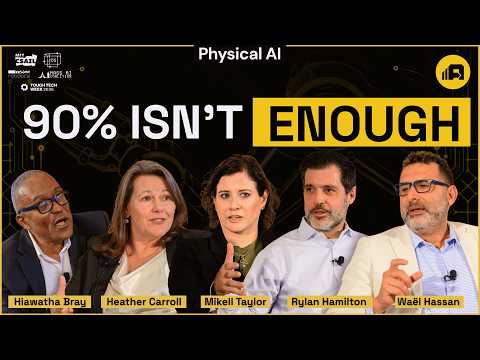
Why a Working Robot Can Still Take Years to Deploy
Waël Hassan, Mikell Taylor, Rylan Hamilton, Heather Carroll, Hiawatha Bray
IIA Physical AI Summit at MIT 2026
Leaders from Zoox, GM, Blue Water Autonomy and Path Robotics explain why robotaxis, factory robots and autonomous ships take years to reach dependable daily use.

Talk
·
2026
Pulkit Agrawal (Eka Robotics): Why Robots Need Practice to Master the Physical World
Pulkit Agrawal
IIA Physical AI Summit at MIT 2026
Pulkit Agrawal explains why robots must practice physical skills, how simulation-trained skills transfer to real robots, and what fast picking rates take.

Panel
·
2026
Why Useful Robots Start With One Boring Job
Alon Kosowsky, Emily Spector, John Fisher, Anand Lalwani, Bruce Welty, Tom Ryden
IIA Physical AI Summit at MIT 2026
Robot builders and a bakery chef on making robots dependable at repetitive jobs like palletizing, fulfillment and cleaning, paying for robot work as a service, and when specialized machines beat humanoids.

Panel
·
2026
Can America Close the Robotics Gap With China?
Elisabeth Reynolds, Harry Asada, Juan Enriquez, Shin-pei Tsay, John Werner
IIA Physical AI Summit at MIT 2026
A panel on whether the United States can turn robotics research into industrial capacity that rivals China, covering factory automation, small manufacturers, procurement, shipbuilding, tariffs and public trust.

Panel
·
2026
Why Robots Need More Than Vision to Handle Objects
Lenore Rasmussen, Alfredo Millán, Rob Weeks, Tom Ryden
IIA Physical AI Summit at MIT 2026
Roboticists from Ras Labs, Berkshire Grey and Festo on grippers, suction and tactile sensing, and why cameras alone miss what happens at the point of contact.

Talk
·
2023
Positive Sum Automation: A Smarter Strategy for Using Robots
Julie Shah
TEDxMIT Salon Dec 2023
Presents research on positive-sum automation, where robots and people work together to gain productivity without losing the flexibility of human teams.
Column
Forbes (John Werner)
Article
·
2026
Amazon's Tye Brady And Boston Globe's Aaron Pressman Talk Robots
Tye Brady, Aaron Pressman
John Werner's Forbes column on a conversation about robots between Amazon's Tye Brady and the Boston Globe's Aaron Pressman.

Panel
·
2025
Intelligent Machines: AI, Autonomy & Robotics
IIA Silicon Valley AI Summit 2025
Panel on moving AI into physical environments: robot learning under uncertainty, safety and data, simulation for humanoids, and useful real-world jobs.

Panel
·
2026
How AI and Robots Are Changing Manufacturing
Reza Zadeh, Cam Myers, Aditya Ranjan
IIA Silicon Valley AI Summit 2026
Paul Baier moderates Reza Zadeh, Cam Myers and Aditya Ranjan on computer vision, robotics and AI agents moving from pilots onto live production lines.

Panel
·
2026
Robotics in the Real World: What It Takes to Deploy Robots at Scale
IIA Davos AI Summit 2026
A robotics founder describes deploying autonomous robots in enterprises, including financing, servicing, insurance, logistics and cybersecurity.

Fireside
·
2026
AI as the Operating System of the Physical World
James Kuffner
IIA Davos AI Summit 2026
James Kuffner of Symbotic on physical AI in warehouses, supply chains and infrastructure, and why reliability and safety matter more than hype.

Panel
·
2026
AI Is Entering the Physical World: Startups Transforming Construction, Robotics, and Industry
IIA Davos AI Summit 2026
Startup founders discuss applying AI to construction, autonomous mining, robotics and talent platforms, and why data is the moat in physical AI.

Panel
·
2025
Embodied Intelligence- Building the Physical AGI
IIA Silicon Valley AI Summit 2025
Panel on embodied intelligence: closing the sim-to-real gap, fusing sensor data, deploying adaptive warehouse robots and keeping humans in the loop.

Panel
·
2026
Robotics at Scale
Navid Aghasadeghi, Annika Thomas, Hasan Khan
IIA AI Summit @MIT 2026
Panel on the engineering, regulatory and commercial hurdles of deploying robots and drones at scale outside the lab.

Panel
·
2026
Can Robots Make Homes Faster and Cheaper to Build?
Frazer Anderson, Vikas Enti, Michael Santora, Mauricio Pereira
IIA Physical AI Summit at MIT 2026
Founders from Reframe Systems, Logic and Industrial Automata on how robots, digital twins and design AI could make homebuilding faster and cheaper.

Panel
·
2026
What Breaks When You Scale From One Robot to Many?
Manthan Pawar, Brandon Contino, Jack Beokhaimook, Abel Seba, Sachit Shenai
IIA Physical AI Summit at MIT 2026
Robot builders from warehouses, greenhouses and delivery sites on what goes wrong when robots leave the lab and how to recover, test and measure.

Panel
·
2026
How AI Tells Warehouse Robots What to Pick Next
Satya Nitta, Thiru Venkatachalam, Roman Nemet, Gabriela Torres V.
IIA Physical AI Summit at MIT 2026
A panel follows a warehouse order from business software to the robots that pick it, and asks what to measure before an AI pilot scales.

Panel
·
2026
Why Scientists Still Do Lab Work Robots Can Handle
Arjun Bindu Sunil, Bingda Li, Anna Marie Wagner, Chase Olle, Oded Maron
IIA Physical AI Summit at MIT 2026
Lab-automation founders on why so much lab work is still manual, the cost, space, flexibility and trust barriers to lab robots, and understanding a customer before pitching.
Column
Forbes (John Werner)
Article
·
2025
Will Robotics Be Good In Your Workplace?
Forbes
AI-enhanced humanoid robots such as Digit are moving toward real-world work by handling focused tasks.
Column
Forbes (John Werner)
Article
·
2025
Robots And American Manufacturing
Forbes
AI-driven robotics and design agents could bring manufacturing back to the U.S. and boost skilled human jobs.
Column
Forbes (John Werner)
Article
·
2025
4 AI Applications To Manufacturing
Forbes
Looks at four ways AI is being used inside the modern factory.
Column
Forbes (John Werner)
Article
·
2026
The Robot House-Builder: Construction At The Speed Of AI
John Werner's Forbes column on robots that build houses and what construction looks like at the speed of AI.

Other
·
2026
Industrial Automata
Mauricio Pereira
TekTrek 2026
MIT student Mauricio Pereira presents Industrial Automata, autonomous construction robots starting with robotic painting.

Other
·
2026
Alluvyum
Anthony Shen, Tian Pu
TekTrek 2026
Princeton founders Anthony Shen and Tian Pu present Alluvyum, an AI-native data and control platform for chemical and materials manufacturing plants.
Column
Forbes (John Werner)
Article
·
2024
Exploring How ChatGPT Might Design A Robot
Forbes
Article on how ChatGPT might design a robot and whether robots will soon build other robots.

Talk
·
2014
One-bit Bots: Robotic Construction Outside the Box
Matt Carney
TEDxBeaconStreet 2014
Matt Carney of MIT's Center for Bits and Atoms on digital materials that give robotic construction crews a structured environment.
Column
Forbes (John Werner)
Article
·
2026
Tutor Intelligence: Why Not Just Teach The Robots Ourselves?
Forbes
John Werner on Tutor Intelligence, a startup whose approach is to have people teach robots their tasks directly rather than program them.
Column
Forbes (John Werner)
Article
·
2026
The Gritty World Needs Ruggedized AI
John Werner on why robots and AI tested in the lab fail in real conditions, and what ruggedized systems need to survive the field.